
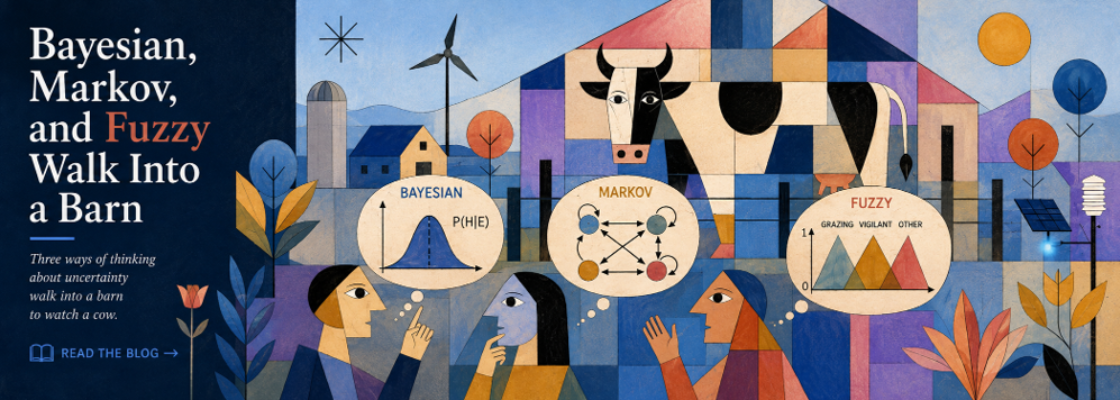
This banner was inspired by Paul Klee, whose work used simple shapes, symbols, and abstraction to explore complex ideas from different perspectives. That feels fitting for a blog about Bayesian, Markov, and fuzzy reasoning, three different ways of looking at the same cow, each revealing something the others might miss.
Three ways of thinking about uncertainty walk into a barn to watch a cow.
The Bayesian says: “I have a belief about what she’s doing, and I’ll update it as I see more.”
The Markov chain says: “I don’t care what she’s doing right now so much as what she just did; that tells me what’s coming next.”
Fuzzy logic sighs and says: “You’re both assuming she’s doing exactly one thing. She’s 70% grazing, 20% vigilant, and 10% deciding whether that noise by the fence line is worth caring about.”
None of them is wrong. That’s the joke, and it’s also the problem. Livestock behavior doesn’t hand you clean labels, so anyone building tools to read it ends up needing all three characters in the room at once.
Why the Barn Is a Hard Space to Work In
Sensor-based livestock monitoring sounds simple until you actually sit with the data. A wearable IMU doesn’t record “lying down”, it records a stream of acceleration values or forces that you infer lying down from. And that inference has to survive a few inconvenient truths about how animals actually behave:
- Behavior is continuous, not discrete. An animal doesn’t teleport between “standing” and “grazing.” It transitions, and the transition itself can be informative, a cow taking longer than usual to lie down might be telling you something.
- There are no clean labels at scale. You can hand-annotate a few hundred hours of video or IMU data, but you can’t hand-annotate a whole herd’s lifetime. Any system has to work from sparse ground truth and generalize.
- Individuals vary. The same “state” looks different animal to animal, and sometimes day to day for the same animal.
- State boundaries are genuinely ambiguous. Even a trained ethologist watching raw footage will sometimes call a behavior differently on a second viewing. If the expert’s own labels are fuzzy, forcing the model into hard categories is asking it to be more certain than the ground truth deserves.
- What happens next depends on what just happened. Behavior has memory. A resting bout is more likely to be followed by another resting bout than a dead-stop switch into vigorous activity.
No single modeling framework handles all five of these cleanly. That’s why the barn needs three different kinds of reasoning, not one clever algorithm.
Bayesian – The One Who Updates on New Evidence
Bayesian reasoning starts with a prior belief and revises it as evidence comes in. In a behavioral monitoring context, that might mean: “based on time of day, recent history, and species norms, this animal is probably resting”, and then updating that belief as new sensor readings arrive, weighting the update by how confident you already are and how surprising the new evidence is.
This turns out to matter enormously for systems that can’t start with a mountain of labeled data, which is every real farm deployment. A useful pattern here is graduated autonomy: a system starts with almost no confidence and defers heavily to human review, then gradually earns the right to act on its own beliefs as its calibration improves. Cold start, to warm start on frozen embeddings, to uncertainty-driven assist-and-review, to calibration-gated auto-acceptance, each rung is really just Bayesian updating made into an engineering discipline. The system isn’t pretending to be certain before it’s earned that certainty.
What Bayesian reasoning doesn’t give you for free is time. A prior can be updated moment to moment, but it doesn’t inherently know that “lying down” tends to follow “lying down” more than it follows “running.” For that, you need the next character at the barn.
Hidden Markov Models – The One Who Remembers What Just Happened
A Hidden Markov Model (HMM) assumes there’s an underlying sequence of states you can’t observe directly (hidden), and each state emits observable signals (the sensor readings) with some probability. Crucially, it also models the probability of moving from one state to the next, the transition structure.
This is the temporal backbone that Bayesian updating alone lacks. It reframes the central question from “what is this animal doing right now” to “what is this animal doing, given what it was just doing, and how likely is a switch.” That reframing is the difference between treating each moment as independent and recognizing that behavior has continuity, bouts, rhythms, sequences.
It’s also the more interesting question scientifically. If continuous behavior really does decompose into a sequence of discrete underlying states, the way speech decomposes into phonemes, or writing into words, then behavior has something like grammar. Whether that compositional structure genuinely exists, and how compact the resulting “vocabulary” of states can be, is an open and testable question rather than an assumption.
The weakness is the same thing that makes HMMs useful: they want hard state boundaries. Real behavior resists being carved into a fixed number of clean categories with sharp edges. Which is exactly the complaint fuzzy logic has been waiting to make while in the barn.
Fuzzy Logic – The One Who Admits Nothing Is That Clean
Fuzzy logic replaces hard categories with degrees of membership. Instead of forcing every moment into exactly one bin, grazing or vigilant or resting, it lets an animal be 70% grazing and 30% vigilant at the same time, and lets that mixture shift gradually rather than snapping between states.
This is a better match for how transitions actually look in raw data. The five or ten seconds before a cow fully lies down aren’t cleanly “standing” right up until the moment they become “lying down” there’s a real, measurable, ambiguous middle. Fuzzy membership functions give that middle somewhere to live instead of forcing an annotator or a model to draw an arbitrary line through it.
What fuzzy logic doesn’t do on its own is sequence or update belief over time, it’s a snapshot tool, good at representing ambiguity within a moment, not across moments. Which is exactly what the other two characters bring to the table.
Why the Barn Needs All Three
The punchline of the joke is that these three don’t compete for the same job. They stack.
- Bayesian priors can inform the transition and emission probabilities inside an HMM, so the model isn’t starting from a blank slate every time it sees a new animal or a new farm.
- Fuzzy membership can soften the hard state boundaries an HMM would otherwise impose, so the “hidden state” isn’t pretending to a precision the underlying behavior doesn’t have.
- And the Bayesian framework can wrap around the whole thing, deciding how much to trust a given inference before acting on it, which is exactly the graduated-autonomy pattern above.
This is roughly the shape you see in the broader precision livestock literature right now, where systems increasingly combine probabilistic state modeling with fuzzy handling of ambiguous transitions rather than picking one framework and forcing the data to comply.
Recent work presented in Behav2Need: Ethology-Driven Animal Need Understanding via Multimodal Sensing on Smart Farms, sits in that same territory: multimodal sensing aimed at inferring animal needs rather than just labeling behavior, which is precisely the kind of problem that resists a single clean modeling choice. Worth a read if you want to see where the field is pushing.
Last Call
The barn doesn’t need a farmer to throw out two of these three and keep one. It needs all three in there, each covering the blind spot the other two share. That’s the actual argument for combining them, not novelty for its own sake, but because livestock behavior is continuous, ambiguous, individually variable, and has memory, all at once. Any tool that only solves one of those problems is going to misread the barn.