
A topic that keeps landing on my desk is digital twinning. It has been an interesting discussion point on my travels, in conversations with experts and colleagues across the US and the EU. And the more I dig into it, the more I think we need to separate the promise from the hype- the proverbial separating the wheat from the chaff, especially when the “thing” we are trying to twin is a living animal.
Why It Works For Machines
Digital twinning has earned its reputation in mechanical systems. Take an engine. Audio, temperature and vibration data can be captured, stored, and modelled so we can test scenarios and run the probabilities of “what if” over time, all anchored to the readings we are seeing right now. That is a genuinely powerful loop, and in mechanical systems we see real improvements come out of it.
The reason it works is that a machine is knowable. The inputs are measurable, the physics is well understood on the instrument, and the failure modes are relatively finite. Feed the model good data, from the right places, and it will tell you something useful about the asset. But get the sensing wrong- the microphone mounted too far from the source, a single temperature probe standing in for the whole system- and the twin is confidently modelling the wrong thing. Even with a machine, placement and quality of the data is everything to that digital system’s performance.
Why Animals Are A Different Problem
Now think about a living organism, and a non-human one at that. A person can give us something close to reinforcement learning in real time: they can tell us what they are doing and how they feel. An animal cannot. That changes the whole paradigm. We first have to understand the measurement itself, and then work out what that measurement is actually telling us about the performance, health and welfare of the animal. There is an interpretation layer that simply does not exist when you are twinning an engine.
And this is where the biological relevance of the data really matters. What signals do we actually need to catch a health or disease event, or a welfare event for example, before it happens? Which behaviours and physiological indicators carry genuine insight, and which are just noise dressed up as data? Until we can answer that, a twin is only as honest as the data behind it, and here is the uncomfortable part: production data, on its own, is far too small-scale, too thin to capture the complexity of the biology, to deliver the kind of insight needed, let alone to feed the needs of the twinning engine.
Take lameness. With no baseline for the cow, her group or the herd, and no near real-time data, a twin has nothing to anchor to and little to offer. But include that baseline plus steady signals like lying times, mobility, and gait from multiple big-data sensor modalities, and it can start to flag early signs and help you decide whether to act. Same twin, completely different value, and the difference is the data underneath it. It still leaves questions on biological relevance: when you only focus on the animal, we also can’t leave out the human interactions or environment; how those are contextualized in this twin environment will be important.
This is also why ethology, the science of animal behaviour, has to sit at the heart of this technology, not on the edge of it. Sensors and models can tell us what changed; it takes people who genuinely understand the animal to tell us what that change means. Keeping that expert human in the loop is how we build real biological relevance into a twin, rather than a convincing-looking guess. And like any science worth trusting, it has to be earned the hard way, through validation and peer review, not vendor claims.
The “Evil Twin” Problem
We have already seen what happens when you build a model on a narrow or skewed picture of the world. Microsoft’s Tay chatbot was trained to learn from public web interactions and had to be pulled offline within about 16 hours after it started producing racist, hateful posts. A couple of years later, MIT’s Media Lab deliberately made the point in reverse with “Norman,” an AI they trained on dark, disturbing content and then presented as the world’s first “psychopath” AI. Same lesson from both: the data you feed a model decides the character of the model. Bad or partial data in, distorted view out. So if we simply pour in the data we currently pull off the farm, is that really the path we want to be on, or are we just building our evil twin?
Apply that to animal agriculture and the stakes are obvious. If we do not give a digital twin a true and complete perspective of the animal, it can quietly drive negative welfare outcomes, poor ROI, or sustainability problems, and we might not even know it was happening. That is the evil twin: a confident model built on an incomplete animal.
And there is a hard commercial reality underneath all of this. A twin is another mouth to feed, they are hungry: more sensing, more data, more compute, more data-center time. For this to work on farm, it has to sit inside the cost economics of a commodity system and still return a clear ROI, so the use case needs to be clearly established and validated long before it ever reaches the animals. That has yet to be demonstrated in livestock AgriTech, and digital twinning is no exception.
What Has To Come First
It’s clear, we need to work towards a new kind of farm system, one where improving the life of the animal is a first-order goal, not a side effect, in balance with the environment. That is not just an animal question; it cascades into human health and environmental health too. That is One Health. But getting there is a lot of unglamorous work before digital twinning with animals becomes credible and becomes a widely accepted farm tool. That’s ok, as there are many future jobs in there, where serious efforts on data standards, databasing, data ownership, and modelling long before the twin itself becomes credible. The validated research on this is still thin, and we should be honest about that.
I am not saying twinning has no near-term place on farm. The mechanical wins will come first, and they will be real: predicting when a milking robot needs maintenance, or making the generator engine perform better and on a more timely schedule. Those are engine problems wearing farm clothes, and twinning is good at them.
But I don’t want us to get carried away when we move to animal health, welfare and behavior, and the real benefit that could be unlocked. I want to be realistic and not jump on a hype bandwagon that is still waiting on the time, resources, investment, and evidence to hold it up. While Digital twinning seems to be the new post-AI topic, and topics like that have a way of racing ahead of the data that is supposed to support them.
Get The Data Right, And The Tools Follow
So my ask is simple: let’s focus on the right data, and on getting farm data infrastructure right, scalable, repeatable, and accurate models built on foundations we trust, bring value to farmers. Do that, and the better tools click into place almost on their own. Skip it, and we are just building convincing models and stacks of animals we do not actually understand, while paying to store crap data in a location that costs real money. Garbage in, is garbage out.
This requires a new paradigm in animal AgriTech, one that treats data foundations as the product, not the plumbing. Digital twinning can absolutely be part of that future- the tractor and the generator, yes, right now, but not yet, not directly, with the animal. Whether we end up with a digital twin or an evil twin comes down to one thing: whether we do the hard work on the data first.
A paper worth further reading – “Please, mind the gap”: A narrative review on digitalization gaps and barriers in the livestock sector – ScienceDirect
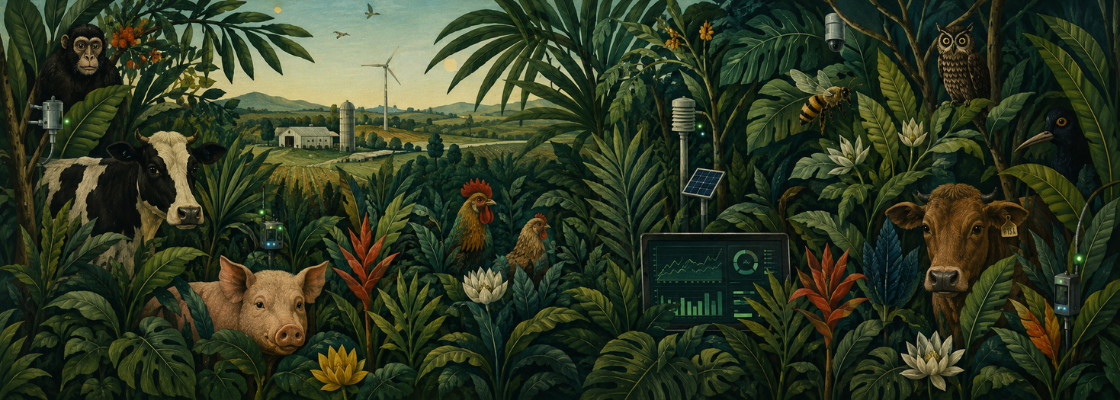
This post’s banner artwork was inspired by Henri Rousseau, a self-taught painter who never set foot out of France or in a jungle, yet dreamed up some of the most famous tropical scenes ever put on canvas. He was laughed at in his day for not being “properly” trained. Arguably, the best ideas don’t always come from the people with the obvious credentials or the well-trodden path. Sometimes it’s about seeing what others haven’t yet.